Showing posts with label Book Reviews. Show all posts

Thursday, November 16, 2017

The Witchwood Crown, by Tad Williams


I am a great fan of Tad Williams' work, in all its many incarnations. The Witchwood Crown is his most recent release and is a fitting continuation of the original story featuring four great characters, Simon Snowlock, Miriamele, Binabik, and Jiriki.

But first, THE BLURB:

The Dragonbone Chair, the first volume of Memory, Sorrow, and Thorn, was published in hardcover in October 1988, launching the series that was to become one of the seminal works of modern epic fantasy. Many of today’s top-selling fantasy authors, from Patrick Rothfuss to George R. R. Martin to Christopher Paolini credit Tad with being the inspiration for their own series.

Now, twenty-four years after the conclusion of Memory, Sorrow, and Thorn, Tad returns to his beloved universe and characters with The Witchwood Crown, the first novel in the long-awaited sequel trilogy, The Last King of Osten Ard.

More than thirty years have passed since the events of the earlier novels, and the world has reached a critical turning point once again. The realm is threatened by divisive forces, even as old allies are lost, and others are lured down darker paths. Perhaps most terrifying of all, the Norns—the long-vanquished elvish foe—are stirring once again, preparing to reclaim the mortal-ruled lands that once were theirs....


MY REVIEW
:

This book is not a light read. Tad Williams' work is brilliant and complex because he understands the character arc and the importance of agency and consequences. Change and growth or degeneration happen to each character over the course of the story—no one is allowed to stagnate. With a character-driven plot set in a fantasy world, the growth of the characters is the central theme. The events, shocking and yet unavoidable, are the means to enable that growth.

The story opens some thirty years after final passages of To Green Angel Tower. Many events have occurred in that time, leaving scars on those who have lived through them. Prince Josua and his family have vanished. The League of the Scroll is no longer what it was, death and age having taken most of the people who had the knowledge. Simon and Miriamele have lost a son to a deadly fever, and are deeply concerned about the behavior of Prince Morgan, their grandson and heir. They have reservations about their son’s widow and fear her influence has ruined him. They also fear for their very young granddaughter, Lillia.

There are other problems for Simon and Miri to contend with. Political unrest, lack of hospitality and rudeness by the King of Hernystir, trouble in Nabban, and rumors that the Norns are stirring. Simon, who has always been gifted (or cursed) with prophetic dreams, is no longer dreaming. A council is held, and it emerges that Binabik the troll also has concerns.

Prince Morgan is more than just a womanizing young noble, but he doesn’t know it. Jiriki and the Sithi will have a large part to play in Prince Morgan’s journey, as they did in his grandfather Simon’s journey to manhood. Whether or not Prince Morgan is the kind of man his grandfather is, remains to be seen.

The Witchwood Crown is an epic fantasy which will put some hoity toity literary purists off. It is literary, illuminating the internal lives of the many characters, and is centered upon how the perception that the king is dying has gendered plots and plans for coups among many factions. This lack of focus on one primary hero will put off the genre purists who need more noise and sixty-second sound bites in their literature. Those readers will find it difficult to follow the many threads.

Osten Ard is a place of contrasts. Dark, in many ways Gothic, negotiating the rough waters of this dark-age world is not easy. The three main cultures differ greatly from each other and are worlds of extremes. These contrasts drive the plot and frame the story in such a way the world of Osten Ard seems more real and tangible than this world. The room in which I read grows colder when the Norns breeze into the narrative.

In the years since the original publication of Memory, Sorrow, and Thorn, Tad Williams has matured as an author. His prose is beautiful, almost poetic yet not going there. Harsh, lush, and carefully designed with layers of allegory and subtext, some readers will find the narrative too literary, difficult to read. Williams has a large vocabulary and sometimes takes the long way rather than dumping you into the fray immediately. He isn’t afraid to use compound sentences, which makes it an adult read. Other, more avid readers, like me, will devour it, savor it, and think about the deeper concepts long after closing the book on the final page.

I give this novel five stars for its complexity, maturity, and sheer originality. A powerful narrative, this book left a different kind of mark on me as a reader than the original series did. That series is young and brash, detailing the early days of kitchen boy who became king. A young and brash author wrote that first amazing series. This book is mature, not only because the author has matured in the craft but because the king is older—it shows us who that boy became, what kind of man he is, and offers us a glimpse of who might succeed him.

I look forward to the next chapter in this very large
story.

Thursday, October 26, 2017

The Hope Store, by Dwight Okita @dwightokita


A poet and playwright, Dwight Okita’s debut novel, The Prospect of My Arrival, a finalist in the Amazon Breakthrough Novel Awards, was one of the more absorbing sci fi novels I’ve ever read. So, I was quite intrigued when I saw he had a new novel out, The Hope Store.


But First, THE BLURB
:

Two Asian American men, Luke and Kazu, discover a bold new procedure to import hope into the hopeless. They vow to open the world's first Hope Store. Their slogan: "We don't just instill hope. We install it." The media descend. Customer Jada Upshaw arrives at the store with a hidden agenda, but what happens next no one could have predicted. Meanwhile an activist group called The Natural Hopers emerges warning that hope installations are a risky, Frankenstein-like procedure and vow to shut down the store. Luke comes to care about Jada, and marvels at her Super-Responder status. But in dreams begin responsibilities, and unimaginable nightmares follow. If science can't save Jada, can she save herself -- or will she wind up as collateral damage?


MY REVIEW
:

Okita’s cerebral yet poetic prose is gentle and approachable, even when depicting the harsher realities of his worlds. Set in a Chicago of the future, the story opens with Jada Upshaw, an amazing, multidimensional character. A well-educated woman, Jada is, at the outset, intent on killing herself. Her despair and confused emotional state is laid bare, but shown with the delicacy and respect Okita brings to all his characters.

Luke Nagano describes himself as “a boy with a big heart but no idea where to put it.” This holds true through the entire novel, as Luke himself is the embodiment of hope. Of Japanese descent, Luke is a native of Chicago, and is deeply rooted in Midwestern American culture. He is deeply in love with Kazu Mori, a rock-star scientist from Tsukuba, Japan. Luke’s thoroughly American blundering through life causes him to make occasional missteps, inadvertent cross-cultural clashes which create tension. Kazu is forgiving, but is completely dedicated to his work. Their love/work relationship drives the plot, also creating tension.

The relationships and thoughts of both Jada and Luke are shown throughout the narrative, but Luke and Jada still have secrets from the reader, keeping me turning the pages.

Okita shows the actual science behind the Hope installation with masterful strokes. Instead of devolving into a drawn-out explanation that most readers would skip, he offers just enough information about the key elements, a framework for the reader to hang their imagination on.

Beyond the great characters and the futuristic setting is the deeper story. Hope, the lack of it, the desire for it, and the lengths we will go to acquire it is what drives this tale. Intrigues, private agendas, and in some cases, desperation drive the story to a satisfying, logical, yet still surprising, finish.

I highly recommend The Hope Store. I found it cerebral, sexy, and thought-provoking, as all Okita’s work is.

Friday, February 19, 2016

Toy Wars, Thomas Gondolfi


Toy Wars, by Thomas Gondolfi was a bit of a departure for me. It is hard sci-fi, so despite the name, it is not a warm and fuzzy sort of book.

But first, THE BLURB:

Don wakes from a normal manufacturing process as a two-meter, sentient teddy bear sporting purple fur. He learns he is the result of a desperate gamble by an autonomous factory with hashed programming. To protect his home, his way of life, and his creator, Don must lead other killer toys across a harsh alien landscape to battle the native fauna of Rigel-3 and even his own kind.

His discoveries change not only his view of the wars, but his own Human gods. In spite of these trials, Don’s harshest test may be getting his own brethren to believe his adventures and the soul-churning changes needed to survive.

MY REVIEW:

This is an intriguing book, with an unusual storyline. The idea of sentient toys battling for supremacy seems at first glance, cartoonish. But it is not, and there is a deep story here.

First, I caution you that there is a large info dump at the beginning. Don't put the book down--stick with it, and you'll find that the story that follows is immersive and well written.

Teddy-1499's journey to self-awareness as 'Don Quixote' is the core of this tale. He is born pre-programmed for certain tasks in the ongoing galactic war, but somewhere along the line, Teddy develops a desire to live, affection, guilt, compassion, and a need to understand the meaning of his life.

Teddy-1499 reads widely, and in Cervantes' 'Don Quixote,' he finds a kindred spirit. He begins finding many parallels in his own situation to that of the mad knight, and when he finds himself in opposition to his creator factories, he takes that as his name.

This novel is techno-based, with a lot of military jargon, which I found daunting but which will appeal to adults who read hard sci-fi with a military-centric plot.

Friday, November 27, 2015

Magic, Mystery, and Mirth: Lindsay Schopfer


Today, I have the always-delightful work of indie author Lindsay Schopfer on deck in the form of a short volume, Magic Mystery and Mirth. This collection of short stories is a great read. The cover is one of the colorful and creative covers of the year.

But First, The Blurb:
Join fantasy author Lindsay Schopfer as he shares eight short tales of adventure and imagination, including…

A genie taken to court for giving bad wishes
A Strange Tales-inspired look at technology in modern society
A reimagining of the banshee myth
A steampunk tale of dirigibles and magic
A sword and sorcery spoof staring a burly wizard, a tall skinny dwarf, a toy dragon breeder, and a tailor
… and more.

Also included is a special sneak peak of Into the North, the upcoming sequel to the steampunk adventure novel The Beast Hunter.

My Review:
Let's face it--I love short story collections. Some of the best, most enduring works of fiction arrive in the form of the short story, and there are a couple of real jewels in this book.

The book opens with Sharp Sword Dull Sword. This particular tale was inspired by being told a contest he was thinking about entering did NOT want any tales involving talking swords.  What emerged from his rebellion is a witty little send-up of every D&D game ever played. If you are looking for snark, this tale is just what you ordered!

My personal favorite in this volume is Disconnected. In this tale, Schopfer voyages into literary, cerebral science fiction, and does it well. This is a thinking person's tale, and was rightfully selected as a finalist in PNWA's annual literary contest. In this tale he explores the place where modern technology and modern society merge.

As a bonus, he gives us a preview of Into the North, the sequel to The Beast Hunter. All the common sense and cold perserverance that Kelton Moore displayed in The Beast Hunter is back in full force in this snippet.

Monday, June 22, 2015

Tenth of December, by George Saunders

Hello!  I'm back after a three-month sabbatical, finishing my own new book and doing some major editing projects for clients. As (I hope) you can understand, I don't read when I am editing, because that is a whole different mindset from reading, and when I am in that frame of mind I dare not try to read for pleasure.

BUT, all was not lost. I listened to several fine audio books, and I have to say that is definitely great entertainment, far more intriguing to me than TV.

So, today I am featuring the audio book version of Tenth of December, a series of short stories by George Saunders. Saunders himself narrates it, and he is an incredible narrator, at least for his own work.

But first, THE BLURB:
One of the most important and blazingly original writers of his generation, George Saunders is an undisputed master of the short story, and Tenth of December is his most honest, accessible, and moving collection yet.

In the taut opener, "Victory Lap", a boy witnesses the attempted abduction of the girl next door and is faced with a harrowing choice: Does he ignore what he sees, or override years of smothering advice from his parents and act? In "Home", a combat-damaged soldier moves back in with his mother and struggles to reconcile the world he left with the one to which he has returned. And in the title story, a stunning meditation on imagination, memory, and loss, a middle-aged cancer patient walks into the woods to commit suicide, only to encounter a troubled young boy who, over the course of a fateful morning, gives the dying man a final chance to recall who he really is. A hapless, deluded owner of an antiques store; two mothers struggling to do the right thing; a teenage girl whose idealism is challenged by a brutal brush with reality; a man tormented by a series of pharmaceutical experiments that force him to lust, to love, to kill - the unforgettable characters that populate the pages of Tenth of December are vividly and lovingly infused with Saunders’s signature blend of exuberant prose, deep humanity, and stylistic innovation.

Writing brilliantly and profoundly about class, sex, love, loss, work, despair, and war, Saunders cuts to the core of the contemporary experience. These stories take on the big questions and explore the fault lines of our own morality, delving into the questions of what makes us good and what makes us human.

Unsettling, insightful, and hilarious, the stories in Tenth of December - through their manic energy, their focus on what is redeemable in human beings, and their generosity of spirit - not only entertain and delight; they fulfill Chekhov’s dictum that art should "prepare us for tenderness".

MY REVIEW:
Wow! For once, a book that has a blurb that really tells the truth. Saunders has the ability to get inside each of his characters' heads, showing them sharply as unique individuals. They aren't always nice, and certainly not always moral as I see morality, but Saunders portrays them with such vivid strokes that you feel as if you understand their reasoning. 

For me, the most powerful tale in this collection of stunning tales was "Escape from Spiderhead." This sci-fi tale has an almost Vonnegut-like flavor. It is a stark journey into the depths to which we humans are capable of sinking in the pursuit of knowledge for the sake of knowledge. Where does punishment end and inhumanity begin? This story lays bare concepts regarding our view of crime and punishment that are difficult, but which are important to consider. The scenario is exaggerated, as it is set in a future world, but it exposes the callous view society has in regard to criminals and what punishment they might deserve. 

I can only say that this was an excellent, entertaining book to listen to, and I liked the audio book so much I bought the hard copy to take with me later this summer when I go on vacation.


Friday, April 3, 2015

Dragons In Pieces, Lee French


Dragons in Pieces, book one of the Maze Beset Trilogy by indie author Lee French is a creative, modern take on the old superhero story.

But first, THE BLURB:

All Bobby wanted was a girl to come home to after a hard day of work. Like the last one said before she left, he was going exactly two places - no and where – and he was happy with that. But somebody had other plans for him. A murder. The Terrorist Watch List. For what? Underage drinking? Things couldn't possibly get worse. Right?

Oh yes, they could.

A lot.

He wouldn't believe superheroes were real if he wasn't one himself.

Tiny robot dragons send him chasing his humanity and his future, on the trail to discovering his past and a place to call 'home'. If he's lucky, maybe he can get a beer there.

MY REVIEW:

I have to say, I like Bobby a lot.  He is a bit of a dumb-ass, who  has been on a certain watch list all his life. He gets picked up for some stupid thing, and instead of Juvenile Detention, they take to a secret facility where they torture him and he goes to pieces--literally.  His physical body fragments in a cloud of tiny dragons the size of an American coin, the quarter.

There is a logic to his superpower. In this state he can think, he can free the others who've been kidnapped and tortured, and he can escape the facility. He can't lift anymore in that state than he can as a human being.  There are limits to his ability, which makes this improbable superhero so enjoyable.

Bobby's fellow inmates, Jayce, Alice, and Ai, all seem to demonstrate superpowers too.  The one other thing they have in common is their eyes are an odd shade of blue, leading them to some conclusions about their personal histories and why they are where they were targeted to be kidnapped by the government. 

Lee French writes well and clearly. Bobby's adventures, while completely improbable, seem perfectly reasonable when you're reading them. The logic behind the superpowers all four demonstrate is what keeps this entertaining book on track.

I highly recommend Dragons in Pieces as a great urban fantasy adventure, with wonderful, well-written characters. It's a complete departure from the usual urban fantasy fare.

Friday, March 13, 2015

Mort, by Terry Pratchett


The great fantasy author, 
Sir Terry Pratchett, O.B.E died on March 12,2015--after suffering from a long battle with Alzheimers. One of the earliest influences on my sometimes smartassed style of writing was his watershed fantasy series, Discworld

Sir Terry took J. R. R. TolkienRobert E. HowardH. P. Lovecraft and William Shakespeare, and many other mythologies, folklores, and fairy tales, and mashed them up in this hilarious series of tales. There were 39 books in this trilogy! Talk about prolific.

One of my favorite books in the series is "Mort." It is the 4th book and is the first to give Death the main storyline.

But First, The Blurb:
Terry Pratchett's profoundly irreverent novels are consistent number one bestseller in England, where they have catapulted him into the highest echelons of parody next to Mark Twain, Kurt Vonnegut, Douglas Adams, and Carl Hiaasen.

In this Discworld installment, Death comes to Mort with an offer he can't refuse -- especially since being, well, dead isn't compulsory.As Death's apprentice, he'll have free board and lodging, use of the company horse, and he won't need time off for family funerals. The position is everything Mort thought he'd ever wanted, until he discovers that this perfect job can be a killer on his love life.


MY REVIEW:
As a teenager, Mort had a personality and temperament that made him rather unsuited to the family farming business. Mort's father, named Lezek, felt that Mort thought too much, which prevented him from achieving anything practical. Thus, Lezek took him to a local hiring fair, hoping that Mort would land an apprenticeship with some tradesman; not only would this provide a job for his son, but it would also make his son's propensity towards thinking someone else's problem.

The conversation between Lezek and his brother Hamish as they discuss Mort's future in the opening pages is hilarious and quite revealing in its simplicity. 

In this snippett, Lezek and Hamish are observing Mort as he attempts to frighten some birds away from the crop. "He's not stupid, mind" said Hamish. "Not what you'd call stupid."

"There's a brain there all right,"Lezek conceded. "Sometimes he starts thinking so hard you has to hit him round the head to get his attention. His granny taught him to read, see? I reckon it overheated his mind."


At the job fair, Mort at first has no luck attracting the interest of an employer. Then, just before the stroke of midnight, a man concealed in a black cloak arrives on a white horse. He says he is looking for a young man to assist him in his work and selects Mort for the job. The man turns out to be Death, and Mort is given an apprenticeship in ushering souls into the next world (though his father thinks he's been apprenticed to an undertaker).


Death is a great character, so completely human in his disenchantment with his career. He retires and Mort's apprenticeship takes off with some amazing ups and downs. 

Death's journey to happiness is one of the more hilarious of the Discworld tales.

I love the snarky way Pratchett took clichés and ran with them. He grabbed the boring, bland, overdone themes of western literature by the tail and swung them. When he set them down they were SO much more fun to watch!

If you love fantasy with humor, and aren't afraid to poke fun at the wry facts of life, Sir Terry Pratchett's work might be for you!

Friday, February 27, 2015

The Belgariad and the Mallorean, by David Eddings

Pawn_of_Prophecy_cover
Two series of books by the late David Eddings  form the basis of a watershed empire in the fantasy pantheon. I have discussed this series several times on this blog--I tend to measure all fantasy books by this epic saga.

Pawn of Prophecy is the opening book in a 5-book series ultimately called The Belgariad. First published in 1982, I have read five paperback copies of these books to death. If you have never read the Belgariad, try the the first book, Pawn of Prophecy,  and if you love fantasy, you will be swept away. Be prepared to sit down and read, because this book is a truly great, immersive read.

I love the opening lines of the first chapter of the opening book in the series, Pawn of Prophecy"The first thing the boy Garion remembered was the kitchen at Faldor's farm. For all the rest of his life he had a special warm feeling for kitchens and those peculiar sounds and smells that seemed somehow to combine into a bustling seriousness that had to do with love and food and comfort and security and, above all, home. No matter how high Garion rose in life, he never forgot that all his memories began in that kitchen."
Queen of Sorcery
A chance visit by an old story teller, Mr. Wolf changes everything, and Garion finds himself and his Aunt leaving the farm in search of something which has been stolen; traveling in the company of Durnik the Smith, and Mr. Wolf.As they travel, they meet up with Silk, a Drasnian spy, and Barak, Cherek Warrior.  Garion soon finds out that no one is what they seem to be.  Silk is actually Prince Kheldar of Drasnia; and Barak is actually the Earl of Trellheim of Cherek.  Only Durnik is who he always was; a good honest man of Sendaria, who just happens to be in love with Pol.

In this first book, Garion doesn't discover who he is, but knowing who he is not is very important, and now he know he is not technically his Aunt Pol's nephew, as he had always believed. This knowledge shakes his world to its foundations, making him fear that he was unwanted. The anger he feels over having been lied to is well portrayed, as is his eventual acceptance of his true path in life.

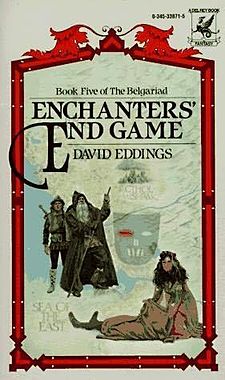
Enchanter's_End_Game_coverThis is a vivid series of books, written from the heart. What David Eddings does in the first chapters of this book is truly magical. He immediately drew me in and within two paragraphs I was immersed in this world--I could smell the smell scents of the kitchen and visualize the people who worked there so companionably in the generous employ of Farmer Faldor. I felt I knew them, and I felt I knew that farm.

These books were comforting right off the launching pad. 

Wikipedia described it as "picaresque" that is, of a genre of prose fiction depicting the adventures of a roguish hero of low social class who lives by his wits in a corrupt society. But just for the record--Wikipedia got it all wrong. It's a coming-of-age story. the tale of a boy  growing up through the events that shape him, becoming a man with strengths and weaknesses, and it is the story of the people he met on that journey.

Guardians of the WestThe Malloreon is a five-part fantasy book series written by David Eddings, which follows The Belgariad. The Malloreon is set in the same world as The Belgariad, but expands on several aspects of the setting, especially the eastern continent of Mallorea. At the end of The Belgariad, Garion has slain the evil god Torak and expects lasting peace.

Things being what they are in a fantasy universe, he does not get it.
The book opens on a peaceful world. The  foundling, Errand, has become Polgara's ward, and he has grown up on the farm with Polgara and Durnik, as their son. The first half of the first book deals with some really humorous situations, as everyone settles into a somewhat peaceful existence.

After eight years as King of Riva, Garion learns that he is still a figure of prophecy and bears the responsibility of defeating Torak's successor, the "Child of Dark." His son is kidnapped, and the next five books of the Mallorean detail the task of getting him back.

This is just as gripping a series of books as the Belgariad.

Belgarath_coverMany times I see authors try to force an exact, detailed picture of their world on the reader, and it ruins the story for me. An author doesn't have to beat me over the head with minute detail; that sort of thing bores me. David Eddings never fell into that trap. Eddings had the ability to convey a sense of place in a few well-chosen words.

David Eddings freely admitted that he wrote all his books with his wife, Leigh Eddings, and in later books of this series she is credited as his co-author.

Friday, February 13, 2015

Heart Search Book Three: Betrayal, by Carlie M.A. Cullen


Today we are looking at the third and final volume in the Heart Search Trilogy by Carlie M.A. CullenHeart Search  book three: Betrayal. I have to say, I love the cover--it really represents the story well, and the book beneath that cover does not disappoint in any way.

BUT FIRST, THE BLURB:
One bite started it all . . .

Joshua, Remy, and the twins are settled in their new life. However, life doesn’t always run smoothly. An argument between Becky and her twin causes unforeseen circumstances, an admission by Samir almost costs him his life, and the traitor provides critical information to Liam. But who is it?

As Jakki’s visions begin to focus on the turncoat’s activities, a member of the coven disappears, and others find themselves endangered.

And when Liam’s coven attacks, who will endure?

Fate continues to toy with mortals and immortals alike, and as more hearts descend into darkness, can they overcome the dangers they face and survive? 

MY REVIEW:
Where to start? It is the third book in the trilogy, and so it picks at the end of the previous book, of course–but a new reader could start with this book and be intrigued.

For me, this book is a roller-coaster of events and emotion, as Samir’s and Joshua’s covens prepare to defend themselves from an upstart rival’s attempted takeover. The disappearance and kidnapping of one of their own casts suspicion on several people, and the discovery of a traitor in their midst is an unpleasant monkey-wrench tossed into the works, making it difficult for Samir and Joshua to know who to trust.

This book has many, many threads that are woven together to create a compelling story of intrigue, Stockholm Syndrome, and the arrogance that comes with immortality. It is filled with strong characters and inventive plot twists—some creepy, some chilling, and some downright horrifying.

Phoenix, the hidden traitor in their midst is an arrogant, self-absorbed twit. We don't find out until nearly the end just who Phoenix is, man or woman. This traitor claims to care for the person handed over as a hostage, but does it anyway, knowing the hostage will not be treated well. Phoenix manages to cause nothing but trouble before their identity is finally revealed.
Their enemy, Liam, is a low-class thug who has no problem starting the equivalent of a gang-war within the vampires’ society. His heavy-handed bullying of his subordinates and cruelty to his victims is evidence of that. His second in command, Max, is a much smarter vampire, a man who could have been quite decent under other circumstances and isn't quite sure that his maker is all that sane.

This is a fitting climax to a wonderful series. It’s a paranormal romance, so some graphic sex and a great deal of violence make this book definitely an adult read.

Friday, January 30, 2015

Metanoia, by Rachel Tsoumbakos


Australian indie author Rachel Tsoumbakos is known for her dystopian fiction, love of all things a bit twisted, and stark settings. Metanoia does not disappoint in any way!

But first THE BLURB:
METANOIA

Definition: n. a spiritual conversion or awakening; a fundamental change of character

Etymology: Greek 'change one's mind, repent'

Marli Anderson has just one task: assassinate Oscar La Monde, the man she once loved.

As assassin for hire for the prestigious Merrick’s Inc., she is sent back to her home town to kill the man she now loathes beyond all others—her husband. Considering they are on opposing sides of the uprising, Marli anticipates an easy task; ‘closure’ they call it. The fact that she can exact her revenge for his past discretions is just the icing on the cake.

When she arrives, the town has changed. The man she hated is unexpectedly welcoming. And the town’s folk—well, they’re just… different. Someone or something has transformed them all into a bunch of zombies. They appear to be harmless - but are they?

As she begins to uncover details of who may be behind the townsfolk’s’ metamorphosis, Marli is left fighting for the truth. Will she and Oscar be able to unravel the web of deception before it’s too late?

Should she trust her heart or her head? Which is less likely to get her killed?

Either way, METANOIA is a heart-stopping zombie apocalypse adventure that will keep you guessing at every twist and turn until the very end.

MY REVIEW:
Let me just say at the outset: this thing starts off with a bang and keeps on going. I don’t normally read books about Zombies, unless the plot is about more than a rehash of lurid B-movies. This is a book about the hard realities of life on the edge, politics, and murder. And contrasting with these dark themes is tenderness, love, and loyalty.

Marli is a strong woman, a loner, and confused in many ways, but she has a backbone and she's not afraid to use it. Oscar is also a strong character, as are the others who make appearances in this tale.

I love the way that just when you think this book is going in one direction, it makes a sharp turn for the intriguing. The stress of life in that society, the environment, and the opposing agendas of the antagonists keep this this tale moving along at a real clip.

The society she places Marli and Oscar in is intricate and eerily possible, and is all the more frightening because it is so possible. All together this book took me away for two days of in-depth reading--mainly because I read it twice, back to back.

I strongly recommend this book to fans of dystopian fiction.


Friday, January 23, 2015

The Blacksmith's Son, by Michael G. Manning


The Blacksmith's Son by Michael G. Manning is an interesting book. It is a voyage of discovery, with plenty of adventure midst a great amount of humor, and is the lead-off book for the Mageborn series. I had a great time with this book.

BUT FIRST THE BLURB:
Mordecai’s simple life as the son of a blacksmith is transformed by the discovery of his magical birthright. As he journeys to understand the power within him he is drawn into a dangerous plot to destroy the Duke of Lancaster and undermine the Kingdom of Lothion. Love and treachery combine to embroil him in events he was never prepared to face. What he uncovers will change his understanding of the past, and alter the future of those around him.

MY REVIEW:
Mort is a great character, both wise beyond his years and naive as heck. Manning goes deep into the world of Lothian, creating characters who are real and who respond to their circumstances in entirely realistic ways. 

At first he his unaware of his birthright, and as his gifts develop and his knack for trouble unfolds, Mort grows into a strong character. I liked the interactions between Mort, his friend of noble birth, Marcus, and his love for good, brave, honest Penny.

Devon Tremont is a complete villain, the perfect evil character, as is Father Tonnsdale. They are well-drawn and dramatic, and both fear Mort's emerging powers.

I liked this story because it is a story. The surroundings of the village and castle, the people within the castle, their values and morals make a great backdrop to this tale of political intrigue and high adventure. 

Friday, January 16, 2015

Kandide and the Secrets of the Mist, by Diana S. Zimmerman


As a grandmother, I often check out books that are suitable to buy for my older grandchildren, books that may not be labeled as young adult. Beautifully illustrated by Maxine Gadd, Kandide and the Secrets of the Mist, by Diana S. Zimmerman is an excellent choice if you or you older child/young adult loves fantasy romance and fairy tales.

But FIRST THE BLURB:

What if everything you love is suddenly gone?

And everything you fear is all you have?

Welcome to Calabiyau. Still a teen in human years, Kandide is the personification of perfection. She is also spoiled beyond belief and vain beyond control. You won’t like her when you first meet her. Nevertheless, she is heir to Calabiyau’s throne and the keeper of the “Gift”—the key to the survival for all Fée.

When a terrible accident leaves her less than perfect, her own mother mercilessly sends her to a treacherous land where strange beasts roam the dark lifeless forest, and even stranger Fée rule its secret kingdom. If she is to survive, Kandide must battle terrifying creatures, as well as her own internal repulsion for the ‘Imperfects’ she is now like. But that is just the beginning of her troubles. Within Calabiyau a presence far more deadly is emerging.

Kandide’s prankster brother, Teren, her tomboy sister, Tara, and a group of misfit Imperfects set off on a perilous journey to save their sister and their land. They must challenge the darkest of forces to face an evil far worse than ever imagined. Calaiyau is forever changed. Or is it? Nevertheless, she is heir to Calabiyau’s throne and the keeper of the “Gift”—the key to the survival for all Fée. When a terrible accident leaves her less than “perfect,” Kandide's own mother mercilessly sends her to a treacherous land where strange beasts roam the dark lifeless forest and even stranger Fée rule its secret kingdom. If she is to survive, Kandide must battle hideous creatures, as well as her own repulsion for the “Imperfects” that she has become. But that is just the beginning of her troubles. Within Calabiyau, a presence far more deadly is emerging. Kandide’s prankster brother, Teren, her tomboy sister, Tara, and a group of misfit Imperfects set off on a perilous journey to save their sister and their land. They must challenge the darkest of forces to face an evil far worse than any imagined. Kandide and her kingdom are forever changed. Or are they?

MY REVIEW:

First, let me assure you that once you work your way past the daunting list of critical praises that make up a good portion of the front of this book, slog through the encyclopedic history of Kandide’s World, and arrive at the map, there is a really good story here midst the ornate descriptions, so stick with it, or skip those parts entirely. The actual story is great and the illustrations will definitely please young readers.

This is a tale that lays bare the falseness of eternally striving to achieve perfect beauty. In true fairytale fashion, this story lays bare the flaw in our own eye. Zimmerman frankly deals with the perception of physical beauty as determining ones worth. Yes, she wraps it up in flowery prose, but she hangs it out there, nonetheless. Vanity, lust for power, the irrational but pervasive fear of people with crippling disabilities, and the callous shunting aside of those less-than-beautiful who live among us forms the core of this tale.

Kandide herself is a little pain in the backside, but don’t quit on her. She is dealt a harsh lesson in compassion, learns to love, and sets out to right some wrongs. I enjoyed this tale enough to overlook the sometimes florid style of writing. It doesn’t ruin the book, and some readers will like that style.

Friday, January 9, 2015

Pawn of Prophecy, David Eddings


Pawn of Prophecy by the late David Eddings is a watershed book in the fantasy pantheon. It is the opening book in a 5-book series ultimately called The Belgariad. First published in 1982, I have read five paperback copies of this book to death.

But first, THE BLURB:

Long ago, the Storyteller claimed, in this first book of THE BELGARIAD, the evil god Torak drove men and Gods to war. But Belgarath the Sorcerer led men to reclaim the Orb that protected men of the West. So long as it lay at Riva, the prophecy went, men would be safe.

But Garion did not believe in such stories. Brought up on a quiet farm by his Aunt Pol, how could he know that the Apostate planned to wake dread Torak, or that he would be led on a quest of unparalleled magic and danger by those he loved--but did not know...?


MY REVIEW:
Many times I see authors try to force an exact, detailed picture of their world on the reader, and it ruins the story for me. An author doesn't have to beat me over the head with minute detail; that sort of thing bores me. David Eddings never fell into that trap. Eddings had the ability to convey a sense of place in a few well-chosen words.

The book opens in the kitchen of a farmhouse with Garion's memories of playing under the table in a kitchen as small child. He, is being raised by his Aunt Pol who works as the cook on a prosperous farm in a place called Sendaria. Garion has friends, and as time progresses he even has a wistful almost-romance with one of the girls there. But all is not as it appears, and Garion knows nothing of the reality of his family or the world he lives in.

He has other friends; Durnik the smith who is in love with Garion's Aunt Pol, and a strange old traveling storyteller, Mr. Wolf whom his aunt seems to know well and whom she grudgingly tolerates despite his strange attire and love of ale.

News arrives at the farm that causes Aunt Pol to abruptly leave, embarking with Garion on a journey of far more than merely a week or two, and he suffers a long period of doubt and depression. Fifteen-year-old Garion is poised on the edge of manhood--half child, and half adult. Obviously they are on the run, and he is fearful and angry at being kept in the dark--and not knowing the truth, be begins to believe his life to that point was nothing but a lie. 

In this first book, he doesn't discover who he is, but knowing who he is not is important. This is a vivid book, written from the heart. What David Eddings does in the first chapters of this book is truly magical. He immediately drew me in and within two paragraphs I was immersed in this world--I could smell the smell scents of the kitchen and visualize the people who worked there so companionably in the generous employ of Farmer Faldor. I felt I knew them, and I felt I knew that farm.

If you have never read the Belgariad, try the the first book, and you will be swept away. Be prepared to sit down and read, because this book is a truly great, immersive read.

Friday, December 12, 2014

Elantris, Brandon Sanderson


I had a hard time getting into this book, but once I did--wow! Elantris by Brandon Sanderson is a deep commentary on fear, lust for power, and humanity.

But first, The BLURB:

Elantris was the capital of Arelon: gigantic, beautiful, literally radiant, filled with benevolent beings who used their powerful magical abilities for the benefit of all. Yet each of these demigods was once an ordinary person until touched by the mysterious transforming power of the Shaod. Ten years ago, without warning, the magic failed. Elantrians became wizened, leper-like, powerless creatures, and Elantris itself dark, filthy, and crumbling.

Arelon's new capital, Kae, crouches in the shadow of Elantris. Princess Sarene of Teod arrives for a marriage of state with Crown Prince Raoden, hoping -- based on their correspondence -- to also find love. She finds instead that Raoden has died and she is considered his widow. Both Teod and Arelon are under threat as the last remaining holdouts against the imperial ambitions of the ruthless religious fanatics of Fjordell. So Sarene decides to use her new status to counter the machinations of Hrathen, a Fjordell high priest who has come to Kae to convert Arelon and claim it for his emperor and his god.

But neither Sarene nor Hrathen suspect the truth about Prince Raoden. Stricken by the same curse that ruined Elantris, Raoden was secretly exiled by his father to the dark city. His struggle to help the wretches trapped there begins a series of events that will bring hope to Arelon, and perhaps reveal the secret of Elantris itself.

My REVIEW:
The setting of this book is the ruined city that once was the shining example of all things wonderful in the world, and which is now a tomb for the living dead. There are three main characters, which was a little offsetting at first, but as I got into the tale, I saw the reason for it, and the story couldn't be told any other way.

Prince Raoden wakes up to find himself afflicted with the curse of 'the shaod,' the physical manifestation of the once beautiful, but now terrible, change. Despite being heir to the throne, he is declared dead and secretly thrust into the city with little food. He finds many reasons to fight against his lot, and struggles to raise the inhabitants of Elantris from the anarchy they have fallen into in their hunger and despair. Raoden is driven to find an answer, to discover the answer to why the Aons no longer work, and to restore their power, thereby returning Elantiris to health.

Sarene is a princess who is married by proxy to the now officially dead Prince Raoden.  She arrives in Arelon, a widow before she has even met her husband, and, despite some roadblocks, immediately takes charge, as she is the only one really suited for the task. She sees the reality that the Arelon nobility ignores, and begins her efforts to both improve the lives of her new people, and head off the impending doom represented by a foreign religion that is poised to take over Arelon. When she realizes what Elantris conceals, and that her husband is there, she takes decisive action, sending food and other encouragement.

Hrathon is the high priest in charge of converting Arelon to his religion and placing a puppet on the throne. His own sense of honor and nobility get in the way of his duty, which sets things up for a spectacular finish. He is complicated, both likable and unlikable.

This is a complicated read, but well worth the effort. The characters are deeply compelling, and Sanderson draws you into his world of magic and logic with precision and a flair for intense drama. I highly recommend Elantris as a one-of-a-kind fantasy set in a distinct and unique world.


Friday, November 28, 2014

The Castle of Otranto, Northanger Abbey, and The Mysteries of Udolpho


It's the end of November, and this seems like the perfect time to go back to the roots of fantasy, to the books that inspired the early twentieth century masters of paranormal fantasy and horror. Authors from Edgar Allen Poe, to H.P. Lovecraft, to Victoria Holt were influenced and inspired by these root classics.

The late nineteenth century was a great era in which the seeds of the genre of fantasy were planted, a time when books chronicling magic, mayhem, and dark mysteries found fertile soil in the imaginations of thousands of educated, book-hungry middle-class men and women. This was the emergence of the Gothic Novel.

Gothic novels have common themes consisting of incidents of physical and psychological terror, remote, crumbling castles, seemingly supernatural events, a brooding, scheming villain, and (most importantly) a persecuted heroine.


The Castle of Otranto is a novel written in 1764 by Horace Walpole. Many consider it to be the first gothic novel, the beginnings of the literary genre that would spawn the likes of Bram Stoker, Edgar Allan Poe, and Daphne du Maurier. Walpole chronicles the story of Manfred, lord of the castle, and his family. The book begins on the wedding-day of his sickly son Conrad and princess Isabella. Just before the wedding, however, Conrad is crushed to death by a gigantic helmet (!) that falls on him from above. This strange, unexplained event is particularly ominous in light of an ancient prophecy “that the castle and lordship of Otranto should pass from the present family, whenever the real owner should be grown too large to inhabit it.” This sets into motion terrible events.

It also suggests that decking your halls with heavy armor may not be a good idea, for all you medieval Martha Stewart(s) out there.

So anyway–Manfred decides the only way for him to avoid destruction is to marry Isabella himself, but first he must divorce his current wife. Isabella runs away, aided by a peasant named Theodore. ” It’s all very melodramatic and exciting, with Isabella hiding in caves, and the fortuitous appearance of mysterious knights, and dark curses. Theodore is revealed to be the true prince of Otranto and Manfred’s daughter, Matilda, dies, leaving Manfred to repent. Theodore becomes king and eventually marries Isabella “because she is the only one who can understand his true sorrow.”

Even Jane Austen loved Gothic novels.


Northanger Abbey was the first of Jane Austen’s novels to be completed for publication, written circa 1798–99. It was originally written as a send-up of the gothic novel, the Mysteries of Udolpho. She died in 1817 and her book was posthumously published.

The book details the adventures of seventeen-year-old Catherine Morland. She is one of ten children of a country clergyman. Although a tomboy in her childhood, by the age of 17 she has read so many Gothic novels that she considers herself to be in training to be a heroine. Catherine reads voraciously, and Ann Radcliffe’s Mysteries of Udolpho is a favorite.

She meets and falls in love with Henry Tilney and after a bit of drama, is invited to visit at his family’s home. Catherine, because of her love affair with Gothic novels, expects the abbey to be exotic and frightening. Sadly, it turns out that Northanger Abbey is a pleasant home and decidedly not Gothic. However, (cue the dramatic music) the house includes a mysterious suite of rooms that no one ever enters. Catherine learns that they were Mrs Tilney’s, who died nine years earlier. Catherine decides that, since General Tilney does not now seem to be affected by the loss of his wife, he may have murdered her or even imprisoned her in her chamber.

I LOVED this novel when I read it while in college in Bellingham, Washington in the 1970s. I wore out three hard-bound copies of it!

So what inspired Jane Austen to write a Gothic novel? It was her own love of a work written an Englishwoman who, in turn, was inspired by the Gothic work of Horace Walpole. The Mysteries of Udolpho by Ann Radcliffe, was published in four volumes on May 8, 1794. Walpole began the genre, but Radcliffe made it popular.


Set in the year 1584 in southern France and northern Italy, the novel details the plight of Emily St. Aubert, a young French woman. Her mother is dead, and while journeying with her father, she meets Valancourt, a handsome man who also feels an almost mystical kinship with the natural world. Emily and Valancourt quickly fall in love. After the death of her father she is sent to live with her aunt, Madame Cheron. Emily suffers imprisonment in the castle Udolpho at the hands of Signor Montoni, an Italian brigand who has married her aunt. Emily’s romance with the dashing Valancourt is frustrated by Montoni and others. Emily also investigates the mysterious relationship between her father and the Marchioness de Villeroi, and its connection to the castle at Udolpho.

Radcliffe’s fiction is characterized by apparently supernatural events that are then provided with rational explanations. She was a forward-thinking woman, as was Jane Austen, in that in all Radcliffe’s works traditional moral values are reinforced, the rights of women are strongly advocated, and reason always prevails. Sir Walter Scott was quoted as saying, in regard to Ann Radcliffe’s work, “Her prose was poetry and her poetry was prose. She was, indeed, a prose poet, in both the best and the worst senses of the phrase. The romantic landscape, the background, is the best thing in all her books; the characters are two-dimensional, the plots far-fetched and improbable, with elaboration of means and futility of result.”

The roots of our modern fascination with all things dark and mysterious goes back to the first stories told by our tribal ancestors, under the stars around campfires. Every tribe (and in later millennia, every family) had a storyteller who wove tales of darkness, of good triumphing over evil, of sin and redemption. When written languages were invented, the upper classes in early societies had literature written for them by the likes of Homer and Li Fang .

In western societies, the renaissance began the great lust for books. With the advent of the printing press and the emergence of an affluent, educated middle-class, reading novels became a popular way to while away one’s well-earned leisure hours in the evening or on a Sunday afternoon. This habit survived, despite frequent, intense puritanical censure of such frivolity.

It is because of those nineteenth century pioneers of early popular literature that we modern readers have such a wide variety of work to entertain us. Kindles and other ebook-readers show up among the patrons of every coffee shop and in every airport-lounge and every doctor’s waiting room.

Much may have changed how we take delivery of that content–few books arrive at my house with thick paper and leather bindings nowadays, but nothing has changed in the desire to just quietly enjoy a good story when one has a little downtime.

(Re-blogged from Life in the Realm of Fantasy, Connie J. Jasperson, author)


Friday, November 14, 2014

Harbinger (The Greatest Sin Book 2), Lee French and Erik Kort


Harbinger is the second book in The Greatest Sin series--and it is  written in such a way that even f I hadn't read the first book, The Fallen, I'd be sucked in. Indie authors Lee French and Erik Kort have written a seamless classic in this series.

But First--the BLURB:
Adjusting to her new life as a soul-bound agent of the Fallen has Chavali pushing herself harder than ever before. Between learning to fight, dealing with idiots, and climbing stairs - lots of stairs - she has little time to waste on thoughts of the future. Or the past.

When another agent fails to report in, Chavali is sent on the mission to discover her fate. Ready or not, she saddles up for a new adventure with new dangers.

The search takes her to Ket, a coastal city slathered in mystery. There, she faces ghosts from her past and demons of her future as she seeks answers. All she seems to find are more questions.

Plague, murder, lies, espionage...this city harbors much more than meets the eye, and maybe too much to handle.

My REVIEW:
Once again, there are several times I would have liked to slap Chavali--but that's part of her charm. She is arrogant, self-centered, and completely uncaring of other people--until she is forced to see that they have feelings too. She stumbles through the afterlife like a bull in a china shop, but she somehow manages to pull it out of the fire.

Once again Chavali is teamed up with Colby and Portia, and a new character, Harris. As in the first book, the surrounding world is vivid and clear. Once character I am waiting to find out more about is Karias, Colby's horse-that-may-not-be-a-horse.

The characters are sharply drawn and their motives drive the plot. Pale, the villain, is a strong, crafty woman, and I really liked that. Robin, Pale's mentor, is still pulling the strings, but he comes into focus more in the tale, as do his plans. 


Harris, the new character, is an excellent foil for Chavali--and provides a little drama as far as Colby's continuing interest in her goes.

All in all, this book is a great way to while away the winter day. But be warned--once you get started reading it, it's hard to put down!

Friday, November 7, 2014

Mythago Wood by Robert Holdstock

Today we are visiting the fantasy classic Mythago Wood, by Robert Holdstock. I am going to say at the outset that it took me ten years to really appreciate this book, but that is because I was unable to figure it out. Then I stopped trying to understand it, and began appreciating the utter beauty of Holdstock's work. This power of prose that Holdstock wields is the reason this book is considered to be a cornerstone of any library claiming to contain the truly great masterpieces of epic fantasy.

But First THE BLURB:

Myth and Terror in the Forest Deeps

The mystery of Ryhope Wood, Britain's last fragment of primeval forest, consumed George Huxley's entire long life. Now, after his death, his sons have taken up his work. But what they discover is numinous and perilous beyond all expectation.

For the Wood, larger inside than out, is a labyrinth full of myths come to life, "mythagos" that can change you forever. A labyrinth where love and beauty haunt your dreams. . .and may drive you insane.

MY REVIEW:
There is a a lot of both history and pre-history in this tale. The tale begins just after the end of WWII. At the outset Stephen Huxley returns from military service, after recuperating from his war wounds, to see his elder brother Christian, who now lives alone in their childhood home, Oak Lodge, just on the edge of Ryhope Wood. Their father, George, has died recently. Christian is disturbed but intrigued by his encounters with one of the mythagos, while Stephen is confused and disbelieving when Christian explains the enigma of the wood. Both had seen mythagos as children, but their father explained them away as travelling Gypsies. Christian returns to the wood for longer and longer periods, eventually disappearing into the wood.Stephen reads about his father's and Edward Wynne-Jones's studies of the wood. Part of his research on the wood causes him to contact Wynne-Jones's daughter, Anne Hayden.

The book  defines a mythago as a "myth imago, the image of the idealized form of a myth creature". Mythagos are dangerously real, but if any of them stray too far from the wood they slowly deteriorate and die. Because they are formed from human myths, they vary in appearance and character depending on the human memories from which they formed. That concept was what I struggled with as a reader, but as I grew to understand it, I was amazed at the possibilities such a notion offered. 

Holdstock's prose is lush and beautiful--even when I didn't understand the concept of the meaning behind the Mythagos I loved the words on the page. And later, when I had begun to understand what had happened to Christian I developed an appreciation for the sheer creative genius of Robert Holdstock as an author and builder of worlds. In Mythago Wood, Holdstock gives us tough questions, deep moral dilemmas, and a seriously epic fantasy world that can never be matched or imitated. 

Monday, November 3, 2014

The King of Ys, series by Poul and Karen Anderson


Today we are revisiting my bookshelf, with a look at series, The King of Ys, by Poul and Karen Anderson. I read this series many years ago, in 1989 to be exact. It was featured as a 2-book book-of-the-month selection for those of us who were members of Doubleday's Science Fiction Book Club, and it was always a happy day for me when my new book would arrive.


THE BLURB:

Ys: Magical city shrouded in legend, where Gratillonius, doomed by the gods to be the last King of Ys, refused to accept defeat, and became a legend that would ring down the corridors of time.


MY REVIEW:

This is the story of Gratillonius, a roman soldier sent by Maximus to act as a prefect for Rome to the country of Ys. Upon arrival he is challenged by The King of Ys for reasons which I was unable to decipher. Gratillonius comes out the victor, and is made king.

The book follows Gratillonius as he navigates both the political and spiritual worlds of Ys. The people of Ys have strong religious ties to their gods, and Gratillonious, a roman soldier, has stong ties to the Roman God Mithras. These beliefs sometimes clash.

He is given nine wives, the Gallicinae, and falls in love with one of them, Dahlis. His preference for Dahlis leads to trouble among the others, and this combined with his lack of understanding about the religion of Ys creates the tension in the tale.

This series has amazing world-building, and rich depictions of the political and religious climate of Breton at the height of the Roman Empire. The characters are real, and in true Poul Anderson tradition, flawed, which leads to their eventual downfall.

I don’t know if the book is still being published. This book can be picked up at a second-hand bookstore, or ordered through Amazon. I do recommend it, if you can get your hands on a copy. It was also published in 1996 by Baen in a two-book compendium, The King of Ys, vols I & II.

Friday, October 24, 2014

The Fallen, by Lee French and Erik Kort

This week we are going deep into a character study, set in an amazing post-apocalyptic world, where magic and mayhem are as natural as breathing. The Fallen, by indie authors Lee French and Erik Kort is one of the better books I've read so far this year.

But first, THE BLURB:
For hundreds of years, the Blaukenev clan has wandered across Tilzam, from one end to the other and back. Each wagon carries history, love, laughter, pain, sorrow, and secrets. Their greatest secret of all may be Chavali, the clan Seer.

Spirits claim/use/save/damn her.

With her gift/curse, nothing surprises her anymore, no one keeps secrets from her. She, on the other hand, has more than enough secrets to keep. Secrets of her own, secrets of her clan, secrets of the world, secrets she even keeps from herself.

There are always people who want secrets.
Some will do anything to get what they want.

The Fallen is the foundation of the story of The Greatest Sin, of a world adrift from its God that desperately wants Her back. Chavali's comfortable, predictable life will be ripped apart and burnt to ashes as she's forced into the middle of that struggle. Change, she hates it passionately. It hates her right back.

MY REVIEW:
Chavali is flat out an awesome character. I can't tell you how many times I wanted to smack her as I read this story. She is feisty and full of passion, stubborn and wrong-headed at times. The Blaukenev clan is unique, joyous and full of life, an enclosed nomadic society that lives in the world and yet outside it at the same time. Their passion for life leaps off the pages.

The contrast between the two societies that Chavali finds herself living in is night and day. In both societies she is forever apart from the rest, both because of her gift and because she is something entirely separate--Blaukenev, and later, Fallen, and a seer cursed with a gift she has little control over.

This is not a romance, though there are tender moments, this is not a book of battles, although there are plenty of those. This is a book about the human journey of life and death that one woman experiences, and it is gripping.

The greatest accolade I can give any story is to say I didn't want it to end. The sequel to this book is due out on October 27, and I intend to be there to get my copy.